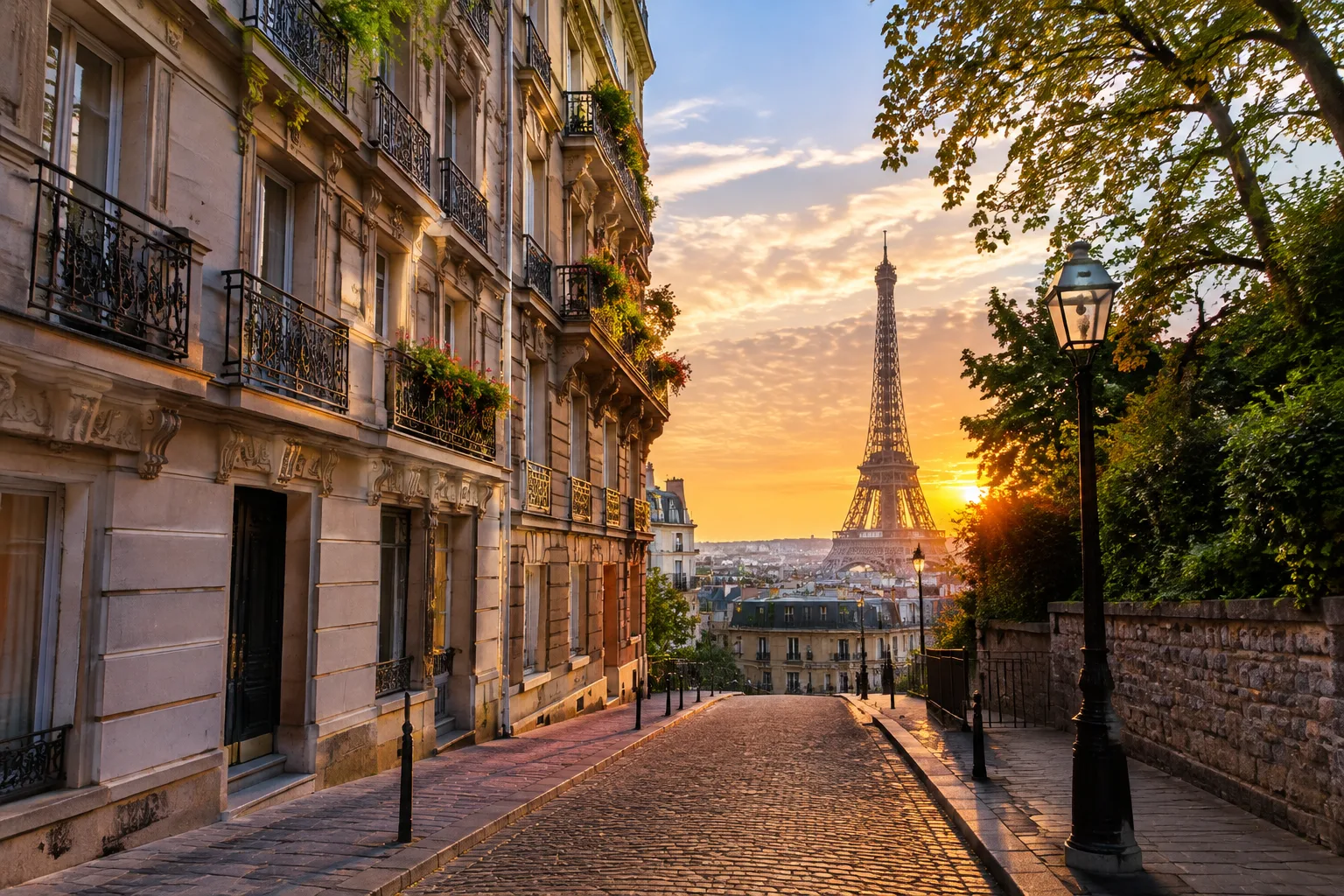
Where can you find the most beautiful streets in Paris without following the usual postcard route? This guide reveals 12 picture-perfect walks, from secret village lanes to grand avenues and colourful façades. You will discover the best streets for photography, quiet morning strolls, architectural details, and memorable Paris moments. Some routes cross famous neighbourhoods. Others hide behind an ordinary metro exit. Together, they show a more intimate Paris, where every corner can become a small travel story.
Village streets with unmistakable Parisian charm
1. Rue de l’Abreuvoir in Montmartre
Rue de l’Abreuvoir is one of the most photographed streets in Montmartre. Its gentle slope leads towards the famous Maison Rose, with Sacré-Cœur appearing just beyond the rooftops. The scene feels almost theatrical, especially early in the morning. Pink walls, climbing plants, old shutters, and uneven paving create a wonderfully compact composition.
Start near Place Dalida and walk downhill towards Rue des Saules. The street becomes quieter as the tourist groups move towards the basilica. Pause beside the Maison Rose, but leave room for residents and restaurant customers. The best photographs usually come from the lower section, where the street opens towards Montmartre’s old vineyards. Add Rue des Saules to your walk for a more rustic atmosphere.
2. Rue des Thermopyles in the 14th arrondissement
In the busy 14th arrondissement, Rue des Thermopyles feels like a sudden escape from Parisian traffic. Its cobblestones, private houses, small gardens, and ivy-covered walls create a village atmosphere. The street follows an old path connected with the historic village of Plaisance.
Walk slowly from Rue Raymond-Losserand. The most attractive section lies between old workshops and modest residential façades. Look for colourful doors, climbing roses, and tiny details around the entrances. Rue des Thermopyles remains a residential street, so silence matters here. Visit in spring, when the greenery frames the façades beautifully. Nearby, Villa Santos-Dumont offers another charming detour for architecture lovers.
3. Rue de l’Ermitage in Belleville
Rue de l’Ermitage reveals Belleville’s creative and village-like side. The street climbs gently through an area filled with small houses, former workshops, painted walls, and surprising gardens. It also runs close to Parc de Belleville, one of the best places for a wide view across Paris.
The architecture changes constantly during the walk. One doorway looks almost rural, while the next belongs to an artist’s studio or a renovated townhouse. The street feels more lived-in than polished, which gives it a distinctive personality. Continue towards Rue de la Mare and Rue des Cascades. This area rewards curious walkers who enjoy details more than grand monuments. Keep your camera ready, because the best view often appears between two parked bicycles.
Colourful façades and memorable residential lanes
4. Rue Crémieux near Gare de Lyon
Rue Crémieux is Paris’s most famous colourful street. Its small terraced houses display pastel façades in shades of blue, yellow, green, and pink. Painted shutters and decorative doors complete the cheerful scene. The street looks particularly striking under soft morning light.
Residents have faced increasing crowds in recent years. Photography should therefore remain discreet, and visitors should avoid blocking entrances. The street is short, making it easy to combine with a walk around the nearby Viaduc des Arts. Start at Rue de Lyon and continue towards Avenue Daumesnil. The contrast is enjoyable: Rue Crémieux offers intimate domestic architecture, while the viaduct presents elegant red-brick arches and former railway workshops. Together, they create one of eastern Paris’s most photogenic walks.
5. Rue Berton in Passy
On the quiet western side of Paris, Rue Berton runs between the hills of Passy and the Seine. Its narrow path, old stone walls, and small houses offer a glimpse of the former village absorbed by the capital. The street is especially atmospheric near the Maison de Balzac.
Balzac lived in the area while working on parts of La Comédie humaine. His former house now offers a peaceful museum stop, with a garden and views towards the Eiffel Tower. Check the official information from the City of Paris before visiting. Walk along Rue Berton, then continue towards Avenue du Président Kennedy. The changing perspectives make this route ideal for travellers seeking quieter photographs of Paris.
6. Rue de l’Assomption in the 16th arrondissement
Rue de l’Assomption offers a polished but surprisingly peaceful walk through the 16th arrondissement. The street combines elegant apartment buildings, private mansions, mature trees, and carefully maintained gardens. It is less famous than nearby Rue Berton, which makes the experience more relaxed.
Begin close to Rue de Passy and continue towards the residential streets around La Muette. Art Nouveau details appear on several façades, including curved balconies and decorative stonework. The nearby Jardin du Ranelagh provides a pleasant break beneath large trees. This walk suits travellers who enjoy architectural photography without constant crowds. On weekdays, the neighbourhood feels particularly calm. At weekends, local families fill the parks, giving the area a more everyday Parisian atmosphere.
Historic lanes in central Paris
7. Rue des Barres in the Marais
Rue des Barres is one of the loveliest medieval lanes in Paris. Its old paving climbs gently towards the Église Saint-Gervais-Saint-Protais. Half-timbered houses, narrow façades, and a small stone staircase give the street an unusually historic appearance.
The best approach begins at Rue François-Miron. From there, walk towards the church and stop near the top of the street. The view back towards the rooftops feels remarkably cinematic. Visit early, when the morning light reaches the façades and the area remains quiet. Continue towards the Seine and Île Saint-Louis afterwards. The route also passes close to the Musée Carnavalet, an excellent stop for understanding Paris’s long and complicated history.
8. Rue Vieille du Temple in the Marais
Rue Vieille du Temple combines historic architecture with the lively energy of the Marais. Its route crosses former aristocratic districts, Jewish heritage sites, independent shops, galleries, and busy cafés. The façades change every few metres, making the walk visually rich.
Start near Rue de Rivoli and continue north towards Rue de Bretagne. Watch for carved doorways, sculpted masks, old signs, and elegant hôtel particulier entrances. The street becomes busier around Rue des Rosiers and Rue des Francs-Bourgeois. For a quieter detour, enter one of the side streets around Square du Temple. This is a good walk for visitors who want photographs and atmosphere together. Come on a Sunday, when many Marais shops open and the neighbourhood feels especially animated.
9. Rue Mouffetard in the Latin Quarter
Rue Mouffetard descends through one of Paris’s oldest neighbourhoods. Its narrow shape follows an ancient route towards the Bièvre valley. Today, market stalls, bakeries, cheese shops, and small restaurants bring constant life to the street.
The lower section near Place de la Contrescarpe feels lively and sociable. The upper section becomes quieter and more residential. Look closely at the old shopfronts, painted signs, and irregular façades. Food lovers should arrive before lunchtime, when the market atmosphere is strongest. The street can become crowded, so keep your walk moving and avoid stopping in the centre. Nearby, Rue du Pot de Fer offers a narrower and more intimate continuation. The Panthéon is also within walking distance.
Streets with water, views, and grand scenery
10. Rue de l’Université beside the Eiffel Tower
Few Paris streets create a stronger first view of the Eiffel Tower than Rue de l’Université. Near the western end, the tower rises dramatically above a long perspective of elegant buildings. The composition changes with every step, especially between Rue de la Manutention and Avenue de la Bourdonnais.
Come at sunrise for softer light and fewer visitors. The morning also reduces the number of parked vehicles, which can interrupt the view. Keep walking towards the Champ de Mars, then continue to the tower’s base. The route works beautifully with a Seine-side walk afterwards. For practical details, including opening hours and tickets, consult the official Eiffel Tower website. The street’s popularity is understandable, but the best photographs often come from a few metres away.
11. Quai de Bourbon on Île Saint-Louis
Quai de Bourbon offers one of the most elegant riverside walks in central Paris. Historic hôtels particuliers line the route, while the Seine flows quietly beside the island. From the quay, you can see the right bank, the bridges, and changing reflections on the water.
The street feels particularly beautiful late in the afternoon. Golden light touches the stone façades and gives the river a warmer colour. Pause near the eastern end for views towards Île de la Cité. The island’s side streets deserve attention too, especially Rue Saint-Louis-en-l’Île, with its boutiques, cafés, and church. Walk respectfully near private residences. This is a superb route for visitors who want classic Parisian architecture without the scale of a major avenue.
12. Rue des Cascades in Belleville
Rue des Cascades carries one of Paris’s most evocative names. The street follows the line of old water sources that once supplied Belleville. Today, it mixes modest houses, artist studios, colourful doors, and fragments of village architecture.
Begin near Rue de la Mare and walk downhill towards Rue de Savies. The route feels intimate, with uneven pavements and small façades that resist grand descriptions. Look for the historic Fontaine du Regard, a reminder of Belleville’s rural past. The nearby Parc de Belleville adds panoramic views and generous greenery. This walk suits travellers who prefer character over perfection. It also connects naturally with Rue de l’Ermitage, creating a longer tour through one of Paris’s most distinctive neighbourhoods.
How to enjoy these picture-perfect Paris walks
The best time for photography is usually early morning or the final hour before sunset. Light becomes softer, streets become calmer, and façades gain more depth. Comfortable shoes are essential, especially around Montmartre, Belleville, and the Latin Quarter. Parisian pavements rarely forgive flimsy footwear.
Use public transport to reach each neighbourhood, then explore on foot. Avoid photographing people closely without permission. Residential streets require extra consideration, particularly Rue Crémieux, Rue des Thermopyles, and Rue Berton. Allow time for detours. A bakery, courtyard, bookshop, or small square often becomes the finest memory of the walk. Paris rewards travellers who leave space in their itinerary for one more corner.
Leave a Reply