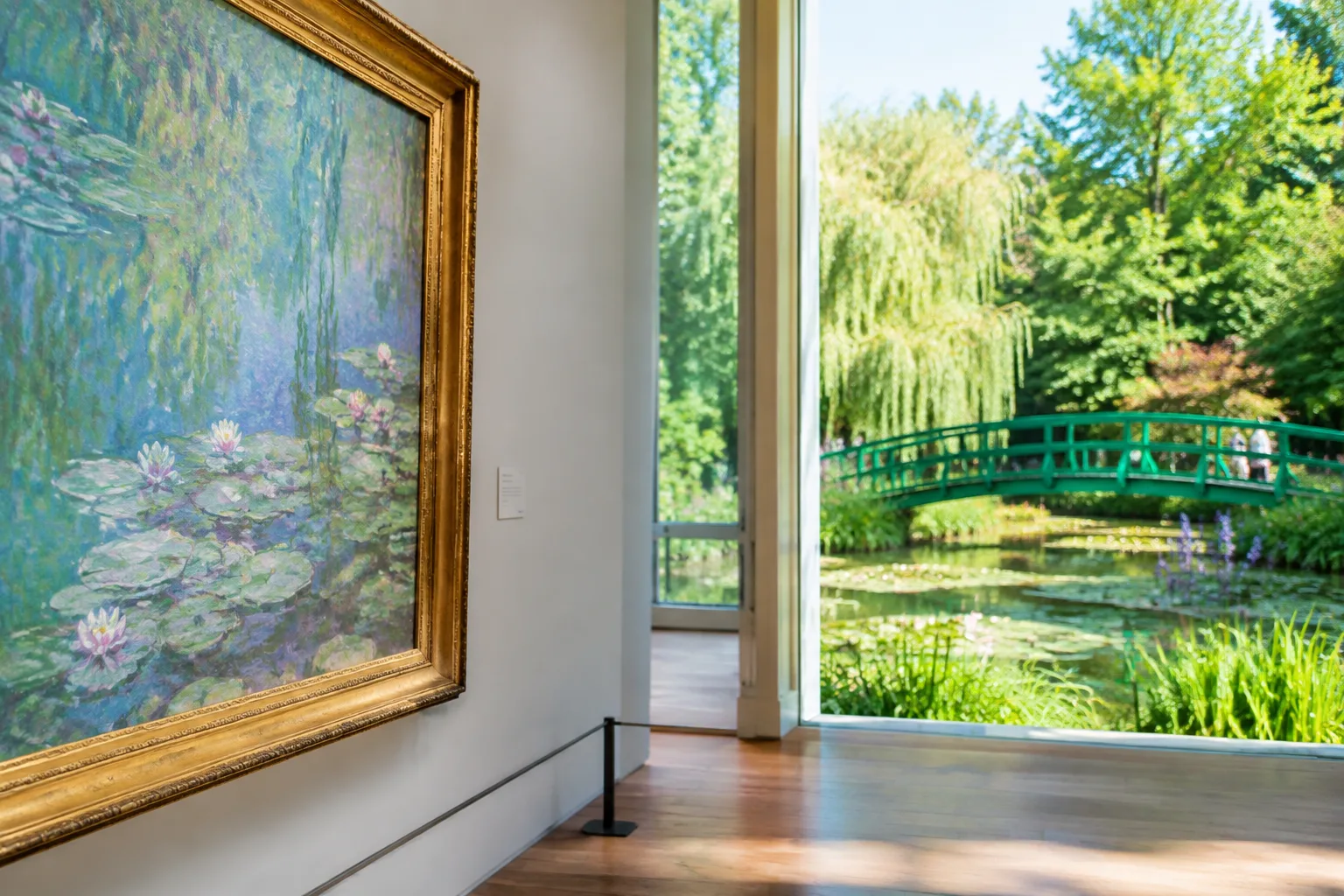
Where can you see Monet in Paris? The answer leads through glowing water lilies, railway steam, Normandy gardens and one very famous sunrise. Paris gathers an exceptional selection of Claude Monet’s work, from intimate studies to vast panoramic paintings. This guide takes you to the best museums, explains which masterpieces deserve your time, and shows where gardens complete the Monet experience. You will also discover how to plan an efficient art walk, with a worthwhile day trip beyond the capital for visitors who want to see the landscape behind the paintings.
Musée de l’Orangerie: Monet’s water lilies in their ideal setting
The Musée de l’Orangerie is the essential Monet stop in Paris. It stands beside the Tuileries Garden, near Place de la Concorde, and houses his celebrated Nymphéas, or Water Lilies. The museum’s two large oval rooms create an immersive experience. Eight monumental panels curve around the walls, surrounding visitors with water, reflections, willow branches and shifting light.
Monet designed the series for a peaceful, almost contemplative space. The paintings stretch across more than 90 metres, yet their details remain surprisingly delicate. Stand close and the surface breaks into loose touches of blue, green, pink and violet. Step back and the pond becomes atmospheric, open and almost endless.
The best moment usually comes after the first impression. Sit on the central bench and let your eyes adjust. The paintings change as daylight enters through the ceiling. A cloudy Paris afternoon can make the colours cooler. Bright weather brings out warmer tones.
The museum also presents works by Renoir, Cézanne, Matisse and Modigliani. These collections offer useful context around Monet’s generation. Still, the Water Lilies rooms remain the main event. Check the official information on the Musée de l’Orangerie website before visiting. Timed entry and temporary exhibitions can affect the day’s schedule.
Musée Marmottan Monet: the intimate side of the painter
For a deeper look at Monet, head west to the quiet 16th arrondissement. The Musée Marmottan Monet holds the world’s largest collection devoted to the artist. It began with a major donation from Monet’s son, Michel, and has grown into one of Paris’s most rewarding specialist museums.
The collection includes paintings from many stages of Monet’s career. You can follow his development from early landscapes to the luminous late works. The museum also owns Impression, Sunrise, painted in 1872 at Le Havre. Its hazy orange sun gave the Impressionist movement its name after critic Louis Leroy used the title mockingly.
Look closely at the painting’s harbour. Boats, smoke and water emerge through a thin veil of blue-grey paint. The orange sun appears small, yet it dominates the scene. Monet understood the power of a single colour placed in the right position.
Marmottan also offers a more personal atmosphere than the larger national museums. Rooms feel quieter, and the paintings often sit at a comfortable viewing distance. You may encounter studies of Argenteuil, Vétheuil, London or Normandy. Each reveals Monet’s obsession with weather, reflection and changing light.
Allow at least 90 minutes for the permanent collection. The museum stands close to Ranelagh and La Muette metro stations. Its official visitor information lists current exhibitions, opening days and ticket details. This is where Monet becomes a whole career, rather than a familiar row of water lilies.
Musée d’Orsay: Impressionism on a grand Parisian stage
The Musée d’Orsay brings Monet into the wider story of modern painting. The museum occupies a former railway station beside the Seine. Its vast clock, soaring central hall and riverside position already create a memorable setting before the art begins.
Orsay owns several important Monet paintings. The selection changes with loans and exhibitions, but visitors often encounter works from his series on Rouen Cathedral, the Gare Saint-Lazare and the Normandy coast. These paintings show his interest in repeated views. He returned to the same subject because light transformed it from hour to hour.
The Gare Saint-Lazare paintings capture steam rising beneath the station’s iron roof. Monet turned a noisy industrial site into a study of colour and atmosphere. His trains disappear behind vapour, while blue and grey tones mingle with warm metal and daylight.
Other works reveal his fascination with Parisian leisure. Look for river scenes, suburban gardens and lively boulevard views. The paintings connect Monet with Renoir, Manet, Sisley and Pissarro. Together, they explain how Impressionism changed the way artists approached modern life.
Visit early in the morning or later in the afternoon. The galleries become busy around midday, especially during school holidays. Take time for the top floor, where the Impressionist collection is concentrated. Then step outside towards the Seine. Monet’s painted worlds suddenly meet the real Parisian light.
Parisian gardens that complete the Monet experience
Monet loved gardens as intensely as he painted them. In Paris, the Jardin des Tuileries offers the most natural place to continue after the Orangerie. Its formal avenues, clipped trees and long reflecting pools differ from Monet’s garden at Giverny. Yet the changing light across the water creates a clear connection.
Walk from Place de la Concorde towards the Louvre. Pause beside the pools and watch the surface react to clouds, leaves and passing visitors. Monet would have appreciated the constant movement. Paris supplies the brushwork for free, although pigeons remain less cooperative than water lilies.
The Jardin du Luxembourg also suits a Monet-inspired stroll. Its broad basin, chestnut trees and seasonal flowers offer an elegant setting for studying colour. The garden feels more structured than Giverny, with strong perspectives and carefully arranged beds.
For a quieter pause, try the garden around the Musée Marmottan. The surrounding streets feel residential and calm. Ranelagh’s trees provide a pleasant contrast with the museum’s concentrated collection.
These gardens work best between museum visits. They give your eyes a break from gallery walls and sharpen your attention to natural light. After seeing Monet, ordinary reflections become unexpectedly interesting. Even a puddle near the métro may receive a second look.
Giverny: the essential day trip from Paris
Strictly speaking, Giverny is not in Paris. It belongs in any serious Monet itinerary, however. The village lies around 75 kilometres west of the capital and contains the artist’s house and garden. Monet lived there from 1883 until his death in 1926.
The Garden of the Musée des Impressionnismes includes the famous flower garden, with tulips, irises, roses and dahlias arranged in exuberant colour. Beyond the road, Monet’s own garden contains the Japanese-inspired water garden. Its pond, arched bridge, bamboo and wisteria inspired the final Water Lilies series.
Giverny makes the paintings easier to understand. You see the bridge’s structure, the pond’s reflections and the vegetation that Monet observed repeatedly. The garden changes every month, so spring and early summer offer different experiences from September.
Travel by train from Paris Saint-Lazare to Vernon-Giverny, then continue by shuttle, taxi or bicycle. The journey takes roughly one hour each way, depending on connections. Reserve tickets ahead during the main season. The Fondation Claude Monet publishes opening dates and practical information.
If you have only one day in Paris, stay in the city and visit the Orangerie, Orsay and Tuileries. With an extra day, Giverny adds the missing landscape. It turns Monet’s painted reflections into a place you can actually walk through.
How to plan the best Monet route in Paris
A compact route begins at the Musée de l’Orangerie. Arrive near opening time, then walk through the Tuileries towards the Musée d’Orsay. The journey takes around 15 minutes and follows one of central Paris’s most pleasant axes.
Spend two hours at Orsay if you want to explore more than Monet. After lunch beside the Seine, continue towards the Right Bank or return through the gardens. Keep Marmottan for another half-day, since it sits away from the central museum district.
Art lovers with limited time should choose Orangerie and Orsay. Visitors already familiar with the water lilies should prioritise Marmottan. It offers the richest overview and the most surprising discoveries.
Wear comfortable shoes and avoid overloading the schedule. Monet rewards attention, not speed. A single painting can occupy ten minutes when you stop chasing the next famous image. Paris provides excellent cafés between museums, so there is no practical reason to rush.
Book popular museums online, especially at weekends. Check opening days before travelling, since museums may close on different weekdays. Leave space for the unexpected: a glowing Seine, a rainy garden or a small Monet painting that suddenly steals the afternoon.
Leave a Reply