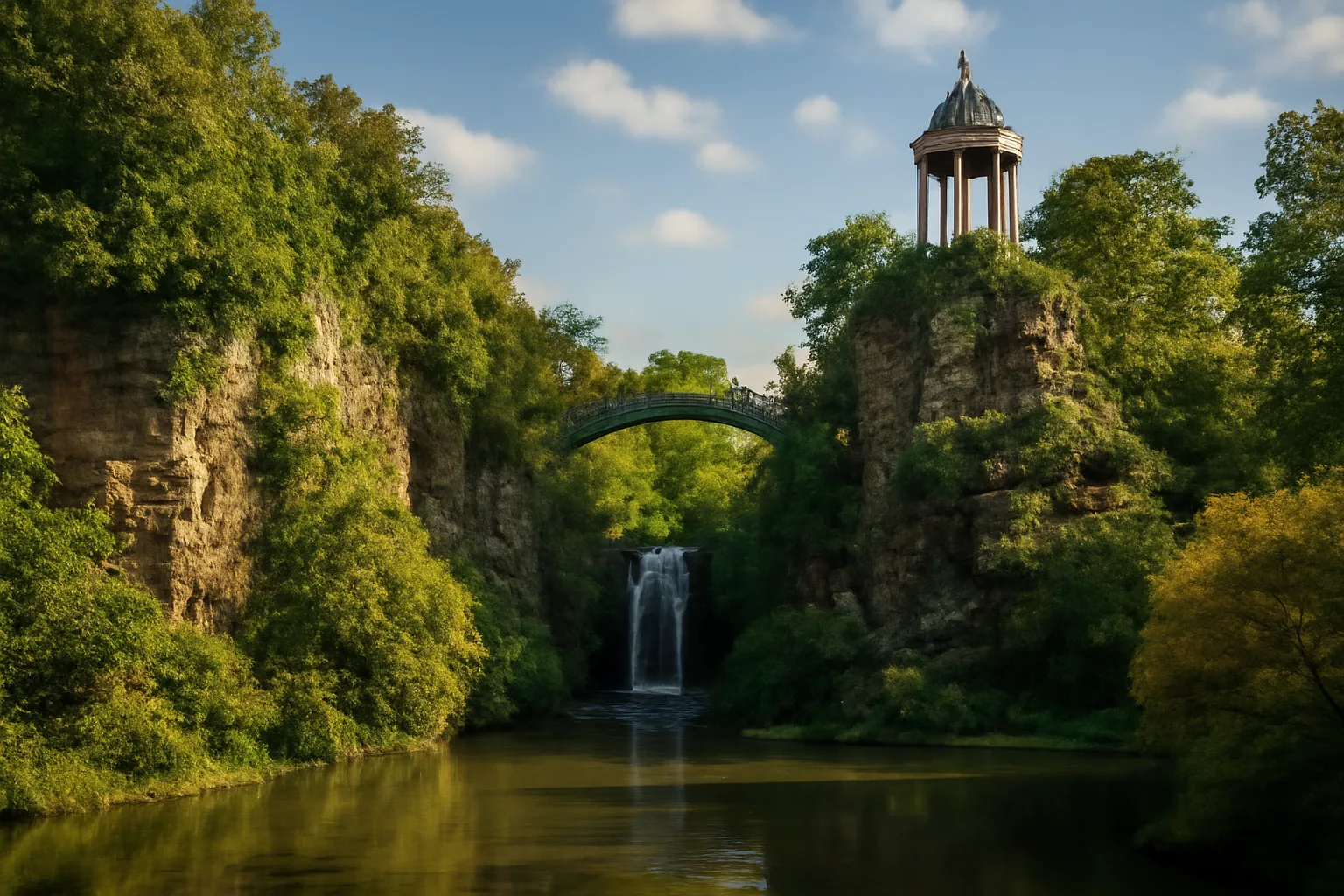
Ever wondered why Parisians slip away to a place that feels more wild than the city? Parc des Buttes-Chaumont answers that question with cliffs, a lake, and a temple clinging to a rocky isle. In this article you’ll learn the park’s surprising history, the best viewpoints for photos, and practical tips to visit like a local. Stay with me: the park’s drama is subtle, but once you know where to look, it becomes impossible to forget.
A theatrical landscape in the middle of the 19th-century city
Parc des Buttes-Chaumont was born from ambition. In the 1860s, Baron Haussmann and his planner Jean-Charles Alphand wanted a park that contrasted with the formal gardens elsewhere. They carved dramatic relief out of an old gypsum and limestone quarry. Engineers shaped cliffs, a grotto, a waterfall and an island. The result feels engineered yet convincingly wild.
The park opened in 1867. It offered Parisians an artificial wilderness within walking distance of dense neighborhoods. Today the park still surprises. People arrive expecting a green square and find a miniature mountain range instead. The park’s Temple de la Sibylle sits like a theatrical prop on a promontory. Visitors climb narrow paths to reach it and discover a sweeping view across Paris.
For a deep dive into the park’s early planning and some archival images, see the City of Paris page Parc des Buttes-Chaumont — Paris.fr. For historical context, the park’s Wikipedia entry also provides useful timelines and references: Parc des Buttes-Chaumont — Wikipedia.
What to see and do: a personal route for first-timers
Start at the eastern entrance near Rue Manin. The first impression is steep slopes and unexpected depth. You’ll immediately understand why photographers adore the place. Follow winding paths and descend toward the artificial lake. Pause for the view across the water to the island and the temple. Light hitting the cliffs at golden hour is especially kind to cameras.
The grotto under the waterfall is a small, dark theater. It was engineered by the park’s original designers to feel like a natural cave. Walk behind the waterfall for an instant that feels like a private unveiling. Nearby, locals spread blankets on sunny lawns. Students read, children play, and older Parisians practice tai chi. The park accommodates many scenes at once.
If you enjoy jogging, choose the higher loop for a proper workout. If you prefer lounging, claim a bench beneath the plane trees near the rond-point. Food vendors and cafés line some entrances, but the best picnic is self-made. Bring a baguette and cheese and pick a spot at the top. The panorama rewards the climb.
Hidden viewpoints and photo spots
Make your way to the Temple de la Sibylle for one of the park’s signature views. The little classical temple sits on a rocky islet and frames Paris beyond. Another secret: the eastern cliff near the Belvédère offers a lower, moodier angle. Early morning brings mist over the water in cooler months. In summer, head there at dusk for long shadows and warm colors.
For candid street scenes, use the lower paths around the lake. They capture families, couples, and the occasional street musician. If you are chasing reflections, wait for a still day and aim at the west-facing bank. And if you want an unusual composition, photograph the temple through branches from the southern slope. Each angle changes the story of the park.
Why Parc des Buttes-Chaumont feels dramatic and underrated
This park’s drama is architectural rather than botanical. Designers created verticality in a city known for flat squares. That verticality creates theatrical moments. Walk a few steps and the skyline shifts. One minute you’re in a valley; the next you’re overlooking rooftops. The eye moves, and so does the mood.
Despite its qualities, Buttes-Chaumont remains underrated for international visitors. It lacks the landmark appeal of the Luxembourg Gardens or the Tuileries. Yet locals treasure it for authenticity. It never feels staged for tourists. Instead, it feels lived-in. That quiet local life is part of the park’s charm. It rewards those who arrive without a rigid checklist.
The park also supports biodiversity. Lawns and rocky faces host diverse plants and birds. In spring, the slopes become a patchwork of color. The combination of human design and ecological life gives the park its living, changing quality. It’s dramatic in a way that grows on you rather than shouting.
Practical tips: when to go, how to reach it, and what to bring
Parc des Buttes-Chaumont sits in northeastern Paris, in the 19th arrondissement. The easiest metro stops are Buttes-Chaumont (line 7bis) and Botzaris (line 7bis). You can also approach from Laumière (line 5) for a quieter entry. Walk times from central landmarks are reasonable; from République it takes about 20 minutes.
Aim for early morning on weekdays if you want solitude. Weekends draw families and picnickers. Golden hour gives the most flattering light. Winters can be blustery on the exposed promontories, so dress in layers. Bring comfortable shoes for uneven paths. The park has public restrooms and benches, but services are limited inside, so bring water and snacks.
Respect local habits: clean up after picnics and keep dogs under control. Photography is welcome, but be mindful of private moments. For exact opening times and seasonal notices, check the official City of Paris page linked earlier. That source stays current and lists rules and occasional closures.
Parc des Buttes-Chaumont resists easy labels. It rewards curiosity and a slower pace. Visit once for the photos; return to discover the park’s small rituals. Parisians do both. You might end up joining them.
Leave a Reply